
With hemophilia, treating a burn is far from straightforward
The healing process looks different for people with bleeding disorders
Written by |

Treatment for burn injuries is usually straightforward: Cool the skin, manage the wound, control pain, and let time do the rest. That’s the version most people are familiar with. When hemophilia enters the picture, though, even a “simple” burn can quietly turn into something far more complicated. To add to the complexity, existing literature on hemophilia and burns is scarce.
My husband Jared’s injury started as a second-degree burn on his hand. At first, it looked like something he could manage at home. The skin blistered dramatically, but that wasn’t new territory for him. He’s had hand blisters before, and like many people, his instinct was to monitor it, keep it clean, and wait it out.
That approach made sense at the time. But as the days passed, the swelling didn’t subside. Intense pain lingered. It slowly became clear that this wasn’t a typical burn, and that hemophilia was likely complicating the picture.

Healing doesn’t move in a straight line
Second-degree burns damage more than skin. They disrupt blood vessels underneath, and for someone without a bleeding disorder, the body usually handles that internal injury on its own, or with minimal help from doctors. With hemophilia, however, bleeding doesn’t always announce itself clearly. Microbleeding can persist beneath intact skin or scabbing, prolonging inflammation and pain even when the wound appears stable.
In my husband’s case, the burn site evolved from blistering to thick scabbing that raised concern for nonviable tissue. What might otherwise have been a straightforward healing process became layered with questions. Was the pain expected, or was bleeding continuing beneath the surface? Was waiting safer, or was delayed intervention creating new problems?
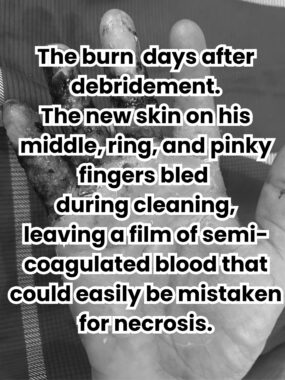
Jared Formalejo’s healing hand after the escharotomy procedure. (Photo by Alliah Czarielle)
The uncertainty was exhausting. Healing didn’t move in a straight line — some days looked better, others worse. Even after debridement, newly forming skin reopened during cleaning and caused bleeding, and with limited factor available, infusing wasn’t a simple or automatic decision. Pain fluctuated without a clear explanation. For anyone watching a loved one recover, that kind of unpredictability is hard to sit with.
When caution becomes its own complication
Medical caution is understandable when hemophilia is involved. In many situations, it’s necessary. But there’s a point where caution can quietly slow care rather than protect it.
Burn treatment often depends on timing. Decisions about debridement, observation, and pain management matter, and delaying them can affect outcomes. In our experience, hemophilia added layers of hesitation — multiple clearances, extended monitoring, and contingency planning — that sometimes felt disconnected from how the injury was actually behaving.
No one was careless. No one was indifferent. But hemophilia can prompt a default toward worst-case thinking, especially among providers who don’t regularly manage bleeding disorders. That mindset, while well-intentioned, can make it harder to respond flexibly to injuries that don’t follow textbook patterns.
Why hemophilia-informed care matters early
Looking back, one thing feels clear: Hemophilia-specific guidance early on could have reduced both stress and uncertainty. Hemophilia treatment centers exist because bleeding disorders intersect with other injuries in unique ways. Factor timing, wound care, and pain assessment don’t always fit neatly into general protocols.
Burns aren’t rare injuries. People with hemophilia will experience them, just like anyone else. The difference is that healing may take longer, look messier, and require closer coordination than standard care anticipates.
Recovery from this injury is still ongoing. Healing hasn’t followed a predictable timeline, and that’s been difficult to accept. But it’s also reinforced an important lesson: With hemophilia, injuries don’t need to be dramatic to deserve careful, informed attention. Sometimes, what looks manageable at first becomes complex — not because anyone made the wrong choice, but because bleeding disorders change the rules quietly, and often after the fact.
Note: Hemophilia News Today is strictly a news and information website about the disease. It does not provide medical advice, diagnosis, or treatment. This content is not intended to be a substitute for professional medical advice, diagnosis, or treatment. Always seek the advice of your physician or another qualified health provider with any questions you may have regarding a medical condition. Never disregard professional medical advice or delay in seeking it because of something you have read on this website. The opinions expressed in this column are not those of Hemophilia News Today or its parent company, Bionews, and are intended to spark discussion about issues pertaining to hemophilia.




Leave a comment
Fill in the required fields to post. Your email address will not be published.