Hemophilia symptoms
 Fact-checked by
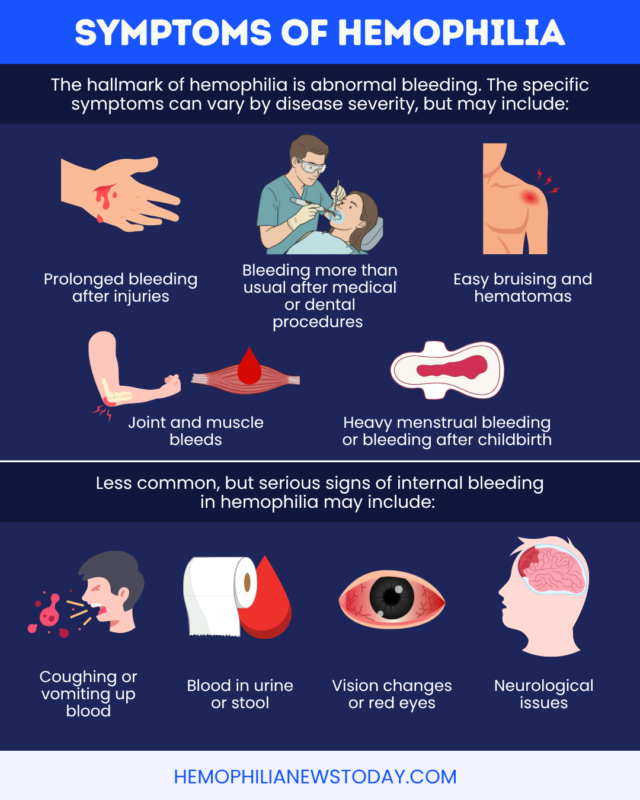
 The main symptom of hemophilia is unusual bleeding. This can be bleeding that lasts longer than normal after an injury or medical procedure, but in more severe cases, it can happen without any obvious cause.
These symptoms arise because people with hemophilia lack certain clotting factors, which are proteins that help the blood form a clot to slow bleeding after an injury. Without them, bleeding is harder to control.
Bleeding in hemophilia may occur externally or internally, leading to a range of possible symptoms, such as bruises, unexplained nosebleeds, heavy or prolonged menstrual bleeding, and pain and mobility issues from bleeding into the joints and muscles. Recognizing the signs of hemophilia is important to ensure a timely diagnosis and prompt treatment.
Excessive bleeding and bruising
Easy and excessive bleeding and bruising — which is a type of bleeding under the skin — are the primary symptoms of hemophilia.
When a healthy person gets a cut, undergoes a medical procedure, or bumps into something hard enough to cause bruising, the body recruits clotting factors to the injury site to slow and then stop the bleeding. Without enough functional clotting factors, people with hemophilia often bleed for longer or develop larger bruises than others after similar injuries.
Exactly what bleeding looks like varies widely by disease severity, which is classified based on the activity of the affected clotting factor:
Scroll horizontally to view all columns -->
| Classification | Clotting Factor Activity | Characteristics |
|---|---|---|
| Mild | More than 5% but less than 40% of normal activity | Bleeds last longer after injuries or medical procedures |
| Moderate | 1% to 5% of normal activity | Bleeds often occur after injury or medical procedures, but may occasionally occur without an obvious cause |
| Severe | Less than 1% of normal activity | Bleeds occur after injury or medical procedures, but also commonly happen without a clear cause |
The major difference is the circumstances most likely to prompt bleeds. Mild or moderate hemophilia symptoms primarily involve abnormal bleeding following an injury or medical procedure, and may not be diagnosed until later in childhood, adolescence, or adulthood. By comparison, individuals with severe hemophilia may frequently experience spontaneous bleeds without a clear cause, which can start before birth or in the first few months of life.
There are two broad categories of bleeds in hemophilia: external and internal.
External bleeding
External bleeding in hemophilia often occurs after an injury or medical procedure, though it can also occur spontaneously. This can include:
- prolonged bleeding from new wounds or injuries
- bleeding that restarts from a wound that had previously stopped bleeding
- bleeding more than usual after surgery or other medical interventions that break the skin, such as vaccinations or circumcision
- frequent or unexplained nosebleeds (epistaxis)
- heavy menstrual bleeding or bleeding after childbirth
- bleeding in the mouth or gums, particularly after dental procedures
While people with hemophilia do bleed for longer after even minor injuries such as cuts and scrapes, they do not bleed faster or more forcefully than people without hemophilia.
Internal bleeding
Most bleeding in hemophilia occurs inside the body. This includes:
- easy and excessive bruising — bleeding from small blood vessels just under the skin
- hematomas — blood pooling deeper under the skin that may form raised, painful lumps
- muscle bleeds
- bleeding into the joints, called hemarthrosis
The joints and muscles are the most common sites of bleeding, particularly in severe forms of the disease. Such bleeds can occur after an injury or without an obvious cause.
Hemarthrosis most commonly affects the ankles, knees, or elbows. A joint bleed may initially cause minor symptoms, such as tingling or warmth over the joint, and later lead to stiffness, swelling, and pain. Muscle bleeds most often affect the arms, hips, and legs. Similarly to joint bleeds, they may cause warmth, numbness or tingling, stiffness, swelling, and pain.
While these are the most common manifestations, internal bleeding in hemophilia can happen essentially anywhere in the body, including major internal organs. This is more likely in people with severe hemophilia, and the symptoms vary based on where the bleeding occurs. Such bleeds are generally considered medical emergencies.
When are hemophilia symptoms an emergency?
Mild hemophilia symptoms can often be managed at home, but certain bleed locations can cause life-threatening complications and should always be treated as medical emergencies. These locations are the:
- Brain or spine: Such bleeds can manifest as prolonged headaches, excessive sleepiness, vomiting, dizziness, confusion, slurred speech, light sensitivity, dilated pupils, seizures, or vision changes.
- Eyes: Vision changes, pain when moving the eyes, or a reddish color in the whites of the eyes are all signs.
- Neck or throat: These bleeds can be marked by swelling or discoloration in the neck, trouble swallowing or breathing, choking, coughing or vomiting up blood, and voice changes.
- Abdomen: Bloody or black stool, vomiting or coughing up blood, abdominal pain, and a swollen or firm abdomen can occur.
- Kidneys or bladder: Signs may be pink, red, or brown urine, lower back pain, frequent urination, or pain when urinating.
Some muscle bleeds can also cause serious complications, including major blood loss and nerve compression. Muscle bleeds in high-risk areas, or those causing rapidly worsening symptoms, should also be treated as an emergency.
Brain bleeds, also called intracranial hemorrhages, are a leading cause of death in hemophilia, though they have become increasingly rare with modern treatments. They are more likely to occur in people with severe hemophilia, children younger than 2, newborns delivered with assistive devices like forceps or vacuums, and older adults, particularly those with high blood pressure. Patients who experience warning signs of a brain bleed should seek immediate medical care.
Complications
Hemophilia bleeding symptoms can cause various complications. Over time, hemophilia joint bleeding can lead to:
- chronic inflammation in the lining of the joints, known as synovitis
- hemophilic arthropathy, a form of irreversible joint damage
- chronic joint pain
Joint issues from recurrent bleeds can ultimately cause significant pain and impair mobility. They can also contribute to weak, fracture-prone bones.
Complications of muscle bleeds may include:
- anemia, characterized by low levels of red blood cells and/or hemoglobin, the oxygen-carrying protein in red blood cells, and unsteady blood pressure
- pain and swelling
- numbness, tingling, and other unusual sensations
Anemia and blood pressure changes can occur when bleeds involve large muscles, leading to substantial blood loss.
Bleeding into smaller, confined muscles, such as those in the calf and forearm, can lead to compartment syndrome, in which increased pressure around a muscle causes swelling and pain. Other unusual sensations may occur if swelling compresses nerves. Compartment syndrome caused by muscle bleeding is a medical emergency, as it can cause irreversible muscle and nerve injury if not promptly treated.
Repeated bleeding can lead to a rare complication called a pseudotumor. This essentially is a slowly growing hematoma that keeps expanding over time to cause damage and pain.
Hemophilia symptoms in babies and children
Abnormal bleeding and bruising are the main hemophilia symptoms regardless of age, but exactly how they manifest can vary over time. Babies and young children are not always able to describe discomfort from internal bleeding. In these young patients, early signs of hemophilia may involve:
- unexplained bruising when a child first begins to walk or crawl
- prolonged bleeding after needle sticks or circumcision
- reluctance to use a specific limb, or to crawl, stand, or walk
- unexplained irritability or fussiness, particularly when a joint or muscle is moved
Hemophilia symptoms in adults may include sex-specific bleeds that won’t occur in children, such as prolonged bleeding with menstruation, childbirth, or other gynecologic procedures. With repeated bleeds over time, adults may also be more likely to develop complications, such as hemophilic arthropathy.
Symptoms by hemophilia severity
Hemophilia severity is a major determinant of the symptoms a person is most likely to experience:
- Mild hemophilia: Bleeds are infrequent and usually caused by a significant injury or major medical/dental procedure.
- Moderate hemophilia: Bleeds and bruises may happen after a greater number of minor injuries and procedures, and thus may occur somewhat more often. Spontaneous bleeding occurs occasionally, and joint and muscle bleeds become more likely.
- Severe hemophilia: Bleeding occurs easily and frequently, and often without an obvious cause. Joint and muscle bleeds are very common, and dangerous internal bleeding is more likely than in milder cases.
Hemophilia symptoms in women and girls
Women and girls are less likely than men and boys to have the most common forms of hemophilia — hemophilia A and B — but can still experience some unusual bleeding if they inherit a disease-causing mutation.
These hemophilia types are related to changes in genes on the X chromosome, one of the two sex-determining chromosomes. Males who inherit a disease-causing mutation on their only X chromosome will have hemophilia. Females have two X chromosomes, so there is a greater likelihood that even if one copy is mutated, the other will be functional, allowing them to produce some working clotting factor. Females with one disease-causing mutation — traditionally called carriers — don’t usually develop severe hemophilia symptoms, but some can experience abnormal bleeding, particularly if they have low clotting factor activity. In rare cases, they can experience symptoms as severe as those of males.
Hemophilia carrier symptoms can include:
- heavy periods or other irregularities in menstruation
- frequent bruising
- frequent nosebleeds
- excessive bleeding following an injury, surgery, or childbirth
- joint damage
Hemophilia News Today is strictly a news and information website about the disease. It does not provide medical advice, diagnosis, or treatment. This content is not intended to be a substitute for professional medical advice, diagnosis, or treatment. Always seek the advice of your physician or other qualified health provider with any questions you may have regarding a medical condition. Never disregard professional medical advice or delay in seeking it because of something you have read on this website.