Hympavzi (marstacimab-hncq) for hemophilia
 Fact-checked by
 What is Hympavzi for hemophilia?
Hympavzi (marstacimab-hncq) is an antibody-based therapy that’s approved in the U.S. to prevent or reduce the frequency of bleeding episodes in adults and children with hemophilia A or B, with or without inhibitors.
In hemophilia, certain proteins needed for blood clotting are either missing or dysfunctional, leaving patients prone to excessive and prolonged bleeding. The deficient clotting protein in hemophilia A is factor VIII (FVIII); in hemophilia B, it is factor IX (FIX).
Hympavzi contains an antibody that blocks the activity of tissue factor pathway inhibitor, a protein that helps prevent unneeded blood clotting.
In doing so, the therapy aims to promote blood clotting through a mechanism that bypasses the need for FVIII or FIX, helping to prevent bleeds in people with either type of hemophilia, including those with inhibitors, which are neutralizing antibodies targeting the missing clotting factor that may render standard factor replacement therapies less effective.
Therapy snapshot
| Brand name | Hympavzi |
| Chemical name | Marstacimab-hncq |
| Usage | Used to prevent bleeds in people with hemophilia A and B |
| Administration | Subcutaneous injection |
Who can take Hympavzi?
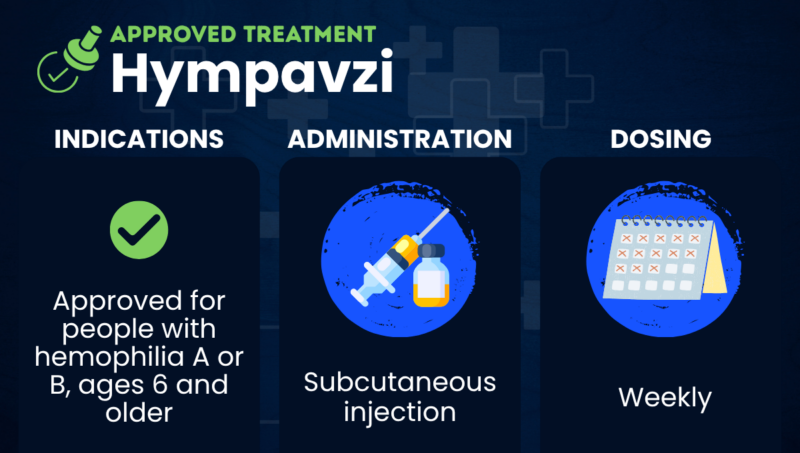
Hympavzi is approved in the U.S. for routine prophylaxis to prevent or reduce the frequency of bleeding episodes in adults and children, ages 6 and older, with:
- hemophilia A, with or without FVIII inhibitors
- hemophilia B, with or without FIX inhibitors
There are no contraindications for its use.
In the European Union, Hympavzi is approved for adults and children with hemophilia A or B, ages 12 and older, with or without inhibitors.
How is Hympavzi administered?
Hympavzi is administered by subcutaneous injection. The recommended dosing depends on a person’s age:
- Adults and children ages 12 years and older: An initial 300 mg loading dose (two 150 mg injections), followed by weekly 150 mg maintenance doses. The dose can be increased to 300 mg in patients weighing at least 50 kg (about 110 pounds) if bleeding is not adequately controlled.
- Children ages 6 to less than 12: An initial 150 mg loading dose (one 150 mg injection or two 75 mg injections), followed by weekly 75 mg maintenance doses. The dose can be increased to 150 mg in patients weighing at least 25 kg (around 55 pounds) if bleeding is not adequately controlled.
The medication comes in single-dose prefilled syringes or pens and can be administered by caregivers or patients ages 12 and older after appropriate training.
Maintenance injections should be given on the same day of each week, at any time of day. The injections are typically administered in the abdomen or thigh, but other sites are acceptable if required. If more than one injection is needed to achieve the required dose, they should be administered in different locations. A healthcare provider will advise families on acceptable injection sites in their individual case.
Additional doses of Hympavzi should not be used to treat breakthrough bleeds. Standard bypassing agents or factor replacement therapies can be used for this purpose.
Hympavzi may need to be temporarily paused before surgery or during severe illness.
Hympavzi in clinical trials
Hympavzi’s U.S. approvals were supported mainly by data from two Phase 3 clinical trials: BASIS (NCT03938792) and BASIS KIDS (NCT05611801).
BASIS tested Hympavzi in adults and adolescents, ages 12 and older, with hemophilia A or B, with or without inhibitors. Before initiating Hympavzi, participants without inhibitors were on preventive (prophylactic) or on-demand treatment with factor replacement therapy. Those with inhibitors had received bypassing agents. The data showed that:
- Among those without inhibitors, Hympavzi significantly reduced annualized bleeding rates of treated bleeds compared with on-demand replacement therapy. It also outperformed prophylactic factor replacement therapy for bleed prevention.
- Among those with inhibitors, Hympavzi significantly reduced annualized bleeding rates of treated bleeds compared with on-demand bypassing agents, and was associated with quality of life gains.
BASIS KIDS is testing Hympavzi in children with hemophilia A or B, ages 1 to 17, with or without inhibitors. Interim data showed that, as in adults, the therapy was generally associated with reductions in bleed rates compared with preventive replacement therapy (no inhibitors) or on-demand bypassing agents (inhibitors) in children ages 6-17.
Hympavzi side effects
The most common side effects of Hympavzi include:
- injection site reactions
- headache
- fever
- joint pain
- diarrhea
- itching
- rash
Hympavzi also comes with warnings for less common but serious complications, including:
- thromboembolic events, or blood-clotting complications that can be life-threatening
- immune reactions to the medication, which may be severe
If these occur, Hympavzi may need to be discontinued.
Hympavzi may cause harm to a developing fetus if used during pregnancy. For female patients of reproductive potential, a negative pregnancy test is required before starting treatment. Effective contraception should be used during treatment and for two months after the last dose.
Hemophilia News Today is strictly a news and information website about the disease. It does not provide medical advice, diagnosis, or treatment. This content is not intended to be a substitute for professional medical advice, diagnosis, or treatment. Always seek the advice of your physician or other qualified health provider with any questions you may have regarding a medical condition. Never disregard professional medical advice or delay in seeking it because of something you have read on this website.