
FDA expands Hympavzi approval to more hemophilia patients
Treatment available to those 6 and older with hemophilia A, B
Written by |

With a new label expansion cleared by the U.S. Food and Drug Administration (FDA), Hympavzi (marstacimab-hncq) is now approved for preventing or reducing the frequency of bleeds in all people with hemophilia A or hemophilia B, ages 6 and older, regardless of inhibitor status.
The injectable therapy was previously approved for adults and children with hemophilia A or B, ages 12 and older, who tested negative for inhibitors, a type of neutralizing antibody that can make standard factor replacement therapies less effective. The new label expands the eligible age range and makes the treatment available to people who test positive for inhibitors.
The FDA’s move makes Hympavzi the first under-the-skin (subcutaneous) non-factor treatment available to children with hemophilia B, ages 6-11, according to its developer, Pfizer.
Pfizer said it is working on seeking similar label expansions in other countries. In the European Union, a recent label expansion extended the therapy’s use to people with inhibitors, but it remains limited to those aged 12 and older.
“With this expanded approval, we believe Hympavzi can become a transformative option and meet a significant medical need for people living with hemophilia A or B with or without inhibitors ages 6 years and older,” Aamir Malik, chief U.S. commercial officer and executive vice president at Pfizer, said in a company press release. “Particularly for children ages 6 to 11 with hemophilia B who will now, for the first time, have a subcutaneous non-factor treatment available.”

Young children, patients with inhibitors have fewer treatment options
People with hemophilia lack certain proteins that help blood clot, leading to excessive and prolonged bleeding episodes. In hemophilia A, the deficient clotting protein is factor VIII (FIII), and in hemophilia B, it is factor IX (FIX).
Standard factor replacement therapies help prevent bleeds by providing a version of the missing clotting factor through routine infusions into the bloodstream. However, some people develop inhibitors against the clotting factor, which can render treatment less effective. These patients have fewer effective treatment options for bleed prevention.
Younger children generally also have fewer approved treatment options than older people.
Hympavzi is an antibody-based therapy that blocks the activity of tissue factor pathway inhibitor (TFPI), a protein that normally helps prevent unneeded clotting. In doing so, it aims to promote blood clotting while bypassing the need for FVIII or FIX.
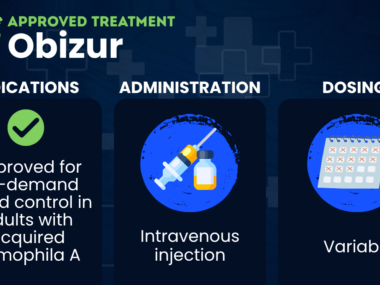
The therapy is administered by weekly subcutaneous injections, which can be done at home by a patient or caregiver with appropriate training. It does not require routine treatment-related lab monitoring.
“For children who have to deal with bleeding episodes from an early age and for people living with hemophilia who develop inhibitors, treatment options have been limited and are often burdensome,” said Guy Young, MD, director of the Hemostasis and Thrombosis Center at Children’s Hospital, Los Angeles. “A treatment that can reduce bleeding with straightforward, once-weekly administration has the potential to fundamentally change how patients and caregivers approach this disease, offering control with a level of simplicity this community has long needed.”
U.S. regulators reviewed Pfizer’s application for the label expansion under a priority review pathway, which shortens the review time for treatments that could provide a significant improvement over available therapies for a serious disease.
The application was supported by data from two Phase 3 trials: BASIS (NCT03938792) and BASIS KIDS (NCT05611801).
BASIS tested Hympavzi in adults and adolescents with hemophilia A or B, ages 12 and older. In the subset of 48 patients with inhibitors, Hympavzi significantly reduced the mean treated annualized bleeding rate by 93% compared with a pre-treatment period in which they only received on-demand treatment with bypassing agents to manage active bleeds. Quality of life was also improved.
BASIS KIDS is testing the therapy in children with hemophilia A and B, ages 1-17, with or without inhibitors.
Interim data showed that the mean yearly treated bleed rate in children ages 6-17 without inhibitors on Hympavzi was lower than a historical model-based bleed rate on routine factor replacement therapy (1.8 vs. 3.6 bleeds per year). Likewise, treated bleed rates among children ages 6-17 with inhibitors on Hympavzi were lower than historical model-based averages with on-demand bypassing agents (1.4 vs. 18.9 bleeds per year).
In the youngest group of children — those ages 6-11 — the model-based mean treated bleed rate was 1.4 per year for those without inhibitors and 1.3 per year for those with inhibitors who had previously been on on-demand treatment.
Across studies, the most common side effects of Hympavzi in adults and children, with or without inhibitors, included injection-site reactions, headache, fever, joint pain, diarrhea, itching, and rash.



Aamir Khan
Congratulations on this important milestone. The FDA’s expansion of Hympavzi for children and patients with inhibitors brings new hope to many families living with hemophilia.
I am a volunteer working with the Hemophilia Welfare Society Balochistan, where we support more than 300 registered patients with Hemophilia A, Hemophilia B, and Von Willebrand Disease across Balochistan, with the valuable support of the World Federation of Hemophilia.
Many children in our region still have limited access to advanced therapies. We would be grateful if opportunities for treatment support, humanitarian aid programs, or patient access initiatives could also reach patients in Balochistan, Pakistan. Every new treatment option offers hope for a healthier and more independent future for our children and families.
Together, we can ensure that no person with a bleeding disorder is left behind. ❤️🩸