
When ‘difficult’ shoes make life with hemophilia easier for my husband
Sometimes, a small adjustment can make a big difference
Written by |

There’s something humbling about watching someone relearn how to walk. Not as a toddler, and not for the first time, but as an adult who already knows what walking used to feel like.
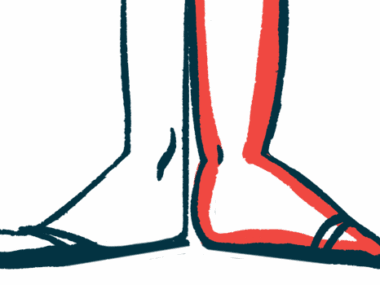
My husband, Jared, has severe hemophilia B, and for years, his right ankle has been what’s known as a target joint — a joint that bleeds again and again into the same space. The damage doesn’t happen all at once. It settles in gradually, first as stiffness, then hesitation, and eventually, as a foot that no longer rolls forward the way it once did.
Chronic joint damage is one of the most common long-term consequences of repeated joint bleeds. In Jared’s case, it has shown up as synovitis, or ongoing inflammation in the lining of his ankle joint. Some days, it feels like stiffness. Other days, it’s hesitation, a resistance when he tries to push off. The joint moves, but not easily, and sometimes with pain.
So when Jared shops for shoes, trendiness is often the last thing on his mind. Though he does like looking sharp, he must first consider ankle support.

When ‘unstable’ feels like relief
When Jared’s two brothers visited Japan, they tried on a popular style of running shoe that was lightweight and had a gently curved sole. They didn’t care much for it, saying that it made balance difficult and almost unstable, as if the ground were tipping slightly beneath them. Stopping was awkward. But the mechanics intrigued Jared, so he decided to try the exact same kind of shoe.
To his surprise, the curve didn’t feel destabilizing, but rather supportive. The subtle rocking motion carried him forward without demanding the rigid push-off that usually irritates his ankle. Instead of forcing a stiff joint to bend the way it once did, the sole absorbed part of the effort. What felt like instability to someone else felt like momentum to him.
He now owns a pair of these supposedly “difficult” and currently trendy shoes. On the first day that he wore them, he came home almost amused by his own discovery. “I can play chase with our daughter now,” he exclaimed.
Our daughter is 7 and highly energetic. She’s the type of child who’ll start sprinting the moment she reaches an open space, at a speed that feels almost competitive. Keeping up with her has never simply been about stamina (which Jared does have a lot of, having been athletic for much of his life), but rather whether his ankle would cooperate.
In the bleeding disorders community, we often focus on the big pillars of care: treatment plans, prophylaxis, and joint protection. Those things matter and are foundational. But living well with a chronic condition also depends on smaller negotiations, the kind that rarely make it into medical conversations.
Sometimes it’s a different insole. A specific chair height or style. Choosing hiking boots over sleeker shoes, or, occasionally, discovering that the trendy option happens to redistribute pressure in a helpful way. None of these decisions reverses joint damage. None of them changes a diagnosis. But they can change what a person is able to say at the end of the day — like, “I can finally play chase.”
Different bodies, different answers
It would be easy to turn this into a recommendation. “Try this.” “Buy that.” “This works.” But that isn’t what this is.
If living with hemophilia has taught our family anything, it’s that no two bodies respond the same way — not to factor levels, not to exercise routines, not to pain management strategies, and certainly not to something as ordinary as a pair of shoes. What destabilizes one person can stabilize another.
For Jared, that curved sole wasn’t solely about following a trend. It was about being able to say yes when our daughter bolts across a field without warning. It meant not calculating every step before joining her. It meant that playing chase could be spontaneous instead of strategic.
Sometimes living well with a bleeding disorder isn’t about dramatic resilience. It’s about experimentation, paying attention, noticing what reduces friction, even slightly, and choosing it to enhance one’s daily life.
We can’t undo years of bleeding into a target joint. We can’t reverse the structural changes that come with it. But we can stay curious about what makes today’s movement easier than yesterday’s.
And sometimes, that small shift — that willingness to try something different — makes the most difference.
Note: Hemophilia News Today is strictly a news and information website about the disease. It does not provide medical advice, diagnosis, or treatment. This content is not intended to be a substitute for professional medical advice, diagnosis, or treatment. Always seek the advice of your physician or another qualified health provider with any questions you may have regarding a medical condition. Never disregard professional medical advice or delay in seeking it because of something you have read on this website. The opinions expressed in this column are not those of Hemophilia News Today or its parent company, Bionews, and are intended to spark discussion about issues pertaining to hemophilia.



Leave a comment
Fill in the required fields to post. Your email address will not be published.