Von Willebrand disease
 Fact-checked by
 Von Willebrand disease (VWD) is a bleeding disorder that, like hemophilia, leads to impaired blood clotting that causes excessive and prolonged bleeding episodes. However, the two conditions differ in their underlying causes and treatment options.
VWD is the most common bleeding disorder, affecting up to 1% of the general population and more than three million people in the U.S., though many individuals experience no significant symptoms. While no cure is available, doctors can prescribe various treatments to control symptoms and improve quality of life.
Causes
Mutations in the VWF gene typically cause VWD. This gene provides instructions for making von Willebrand factor (VWF), a protein that facilitates blood clotting. VWF helps cell fragments called platelets clump together and form a plug that stops bleeding after an injury.
Each VWF gene mutation can affect protein production or function in different ways. In some, insufficient or no VWF is produced, while in others, a dysfunctional version of VWF is produced. Regardless of the mutation, the end result is a lack of functional VWF, which impairs blood clotting.
For the most part, individuals inherit these disease-causing mutations, though spontaneous mutations occasionally occur. In some cases, a child must inherit mutations from both parents for the disease to develop, while in others, a single mutation inherited from one parent can lead to symptoms. VWD affects men and women equally.
Rarely, VWF deficiency occurs later in life as a consequence of other underlying conditions rather than genetic mutations, a phenomenon known as acquired von Willebrand syndrome.
Types
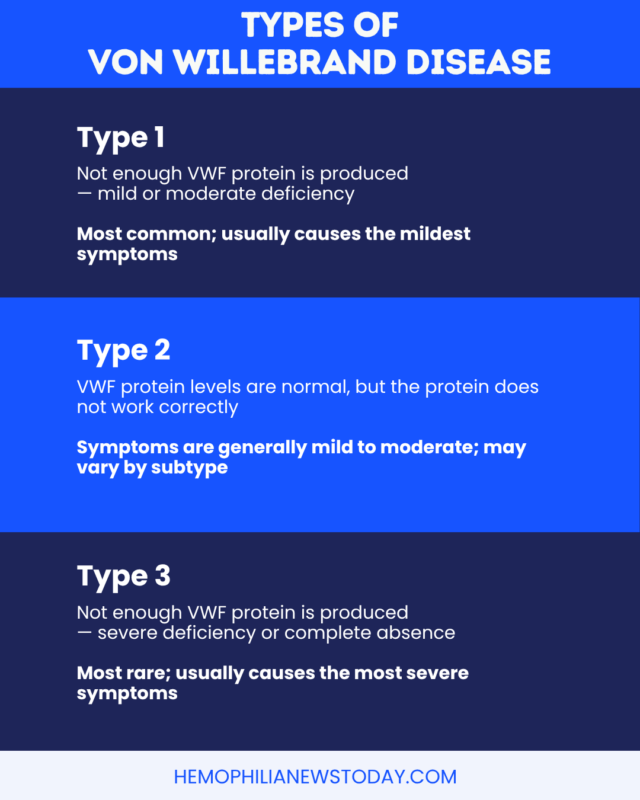
Clinicians categorize VWD into three main types:
- Type 1: VWF protein levels are detectable, but low
- Type 2: VWF is produced, but the protein is abnormal and does not work correctly
- Type 3: VWF protein levels are very low or undetectable
VWD type 1 is the most common type and typically causes the mildest symptoms. VWD type 3 is the rarest type and usually causes the most severe issues. There are also multiple disease subtypes within VWD types 1 and 2 that can affect symptom presentation and inheritance patterns.
Signs and symptoms
Usually, symptoms of VWD are mild and may include:
- prolonged or excessive bleeding from minor injuries, like cuts and scrapes
- frequent or difficult-to-control nosebleeds
- easy bruising, even without an obvious injury
- excessive bleeding after surgery, dental procedures, or childbirth
- heavy menstrual bleeding
Depending on the type and severity of the disease, VWD can also lead to more serious complications, such as:
- bleeding into the gastrointestinal tract, causing blood in the stool
- blood in the urine from bleeding in the urinary tract
- joint bleeding, which can lead to swelling, pain, and joint damage
Blood loss due to VWD can also lead to iron-deficiency anemia, where the body lacks sufficient iron to produce hemoglobin, the oxygen-carrying protein in red blood cells. This condition may be accompanied by fatigue and shortness of breath.
Diagnosis
Because symptoms can be mild or absent, diagnosing VWD can be challenging. After a thorough assessment of symptoms, medical history, and family history, doctors usually run several blood tests to reach a diagnosis. These tests may be used to:
- measure VWF levels using a VWF antigen test
- measure VWF activity
- assess the levels and activity of other clotting proteins
- evaluate how easily and quickly the blood is able to clot
- assess platelet function
- measure the number of platelets and other blood cells
Lab tests may have to be repeated over time so doctors can identify patterns related to VWD and rule out other bleeding disorders. For a person with a history of abnormal bleeding, VWF levels or activity below 30% of normal are usually sufficient to establish a diagnosis.
Genetic testing to identify disease-causing mutations is not required for the diagnosis of VWD, but doctors may use it in some cases.
Treatment and management
For some people, bleeding events are infrequent and mild enough that routine treatment is unnecessary. For people who need treatment, several options are available:
- Desmopressin: Increases the release of VWF from the lining of blood vessels and serves as a first-line treatment to manage milder bleeds
- VWF replacement therapy: Supplies a functional version of VWF to manage more serious bleeds or prevent bleeds on a routine basis in severe cases.
- Antifibrinolytics: Help stabilize and prevent the breakdown of blood clots during procedures like surgery or childbirth.
- Birth control pills: Contain estrogen that increases VWF activity and helps control heavy menstrual bleeding.
In addition to these VWD treatments, doctors advise patients to be careful in situations that could lead to an injury and uncontrolled bleeding.
Hemophilia News Today is strictly a news and information website about the disease. It does not provide medical advice, diagnosis, or treatment. This content is not intended to be a substitute for professional medical advice, diagnosis, or treatment. Always seek the advice of your physician or other qualified health provider with any questions you may have regarding a medical condition. Never disregard professional medical advice or delay in seeking it because of something you have read on this website.