Obizur (susoctocog alfa) for hemophilia
 Fact-checked by
 What is Obizur for hemophilia?
Obizur (susoctocog alfa) is a recombinant, or lab-made, factor VIII (FVIII) replacement therapy approved to help control bleeding episodes in adults with acquired hemophilia A.
In acquired hemophilia A, the immune system mistakenly attacks FVIII, a protein that is important for blood clotting. Standard factor replacement therapies for hemophilia provide the body with a working version of the affected protein. However, in acquired hemophilia, the same self-reactive antibodies that target FVIII produced in the body may also target the replacement version, making acquired hemophilia treatment more complex.
Obizur is a recombinant porcine FVIII product that aims to circumvent this problem by supplying a pig-derived version of FVIII with a slightly different shape than the human protein. This makes it harder for antibodies to target the clotting factor, allowing it to work more efficiently to control bleeding.
Takeda Pharmaceuticals markets the medication, which was originally developed by Baxter and its spinoff Baxalta. It is given directly into the bloodstream, or intravenously.
Therapy snapshot
| Brand name | Obizur |
| Chemical name | Susoctocog alfa |
| Usage | On-demand treatment of bleeding episodes in acquired hemophilia A |
| Administration | Intravenous injection |
Who can take Obizur?
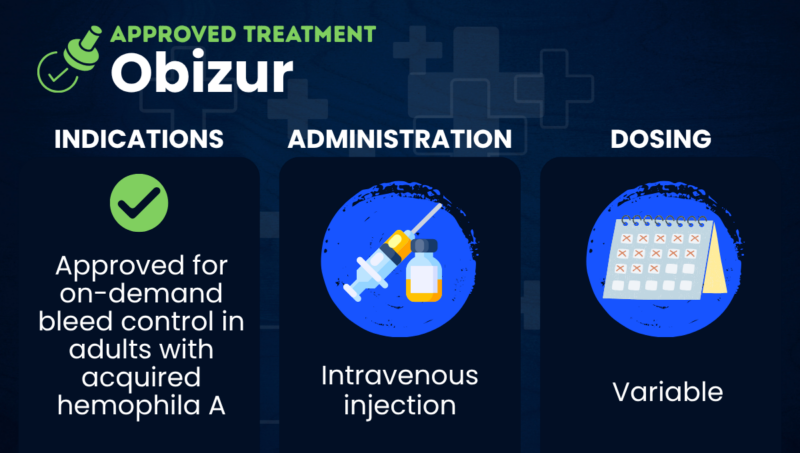
Obizur is approved in the U.S. for the on-demand treatment and control of bleeding episodes in adults with hemophilia A. The medication is similarly approved elsewhere, including the European Union and Canada.
The medication is contraindicated, or should not be used by people with:
- allergies to the medication or any of its ingredients, including hamster proteins
- congenital (inherited) hemophilia A who have developed inhibitors, or neutralizing antibodies against a prior replacement therapy
It’s also not indicated for people with von Willebrand disease, an inherited bleeding disorder. The safety and effectiveness of Obizur in people with existing antibodies against pig-derived FVIII are not established.
How is Obizur administered?
Obizur is given as a slow intravenous injection, administered by a healthcare provider experienced in hemophilia treatment.
The recommended starting dose is 200 units per kg of body weight every four to 12 hours. However, the precise dosage, as well as the frequency and location of the injections, depends on the patient’s clinical condition and the severity and site of the active bleed.
Throughout treatment, healthcare providers will measure patients’ FVIII activity and adjust the dosage as needed to achieve the target activity level.
Obizur in clinical trials
The approval of Obizur for acquired hemophilia A was supported by an open-label Phase 2/3 study (NCT01178294) that involved 28 adults with acquired hemophilia A who were experiencing a serious bleeding episode. Doctors administered the first intravenous injection at 200 units/kg, with additional doses given as needed to control bleeding. The results from this Obizur clinical trial showed that:
- FVIII activity increased by a median of 203% immediately after the first dose, and was maintained at 108% 24 hours later
- bleeding was stopped or significantly reduced within 24 hours of the first dose for all participants
- bleeding was ultimately controlled for 85.7% of participants, with higher success rates in people who received Obizur as the initial therapy relative to those who were first given other treatments (94% vs. 73%)
- the median required dose decreased over time among people who required treatment for more than one day before achieving bleed control
Obizur side effects
The most common side effect with Obizur in clinical trials was the development of antibodies against recombinant porcine FVIII. These inhibitors and other types of immune responses can reduce treatment effectiveness. Doctors may test for these antibodies before Obizur is started, and at any time the medication is not controlling bleeding or increasing FVIII activity as expected.
Obizur may rarely cause severe allergic reactions, including a systemic reaction called anaphylaxis that can be life-threatening. If signs of an allergic reaction occur, Obizur should be stopped, and the patient should be given appropriate treatment. Allergic reactions may involve swelling, chest tightness, shortness of breath, low blood pressure, wheezing, hives, or itching.
Hemophilia News Today is strictly a news and information website about the disease. It does not provide medical advice, diagnosis, or treatment. This content is not intended to be a substitute for professional medical advice, diagnosis, or treatment. Always seek the advice of your physician or other qualified health provider with any questions you may have regarding a medical condition. Never disregard professional medical advice or delay in seeking it because of something you have read on this website.